The windswept and dramatic coastal region of Brittany in north-western France is ruggedly beautiful and full of picturesque medieval towns, prehistoric monuments, incredible beaches, museums, architectural gems, and a unique Breton culture and heritage. It is, however, most famously a scenic region where astounding views, fresh air, great walks, and endless outdoor pursuits await. The beauty of its coastline is its greatest boon by far and those who find a vacation rental in Brittany are likely coming to seek out the stunning surroundings and adventures that it affords. If you are a serious water baby or lover of the sea and want to learn even more about this important part of life in Brittany and the various fascinating creatures sustained by the ocean around Brittany and beyond, then we highly recommend setting aside some time to visit Océanopolis during your holiday in the region...
Océanopolis is located in the town of Brest and is a rather extraordinary aquarium that boasts three different buildings, fifty different enclosures, and over a thousand different marine species. Vast and impressive, it is the National Center for Scientific Culture dedicated to the Ocean in France and hosts a whopping 60% of French oceanographers and related research scientists! Alive with research, conservation, learning, and fun, this is a truly exceptional gem and must-see. In fact, it is actually the most-visited fee-paying tourist attraction in the entire region and has welcomed more than ten million visitors since it was opened back in 1990. With so much to see – you can take a tour of all of the seas and oceans and their inhabitants from around the world in the one place! - it will take a whole day to see it all but it is definitely worth it.
Conceived of as a joint aquarium-museum project back in the 1980s by marine biologist Éric Hussenot and oceanographer and specialist in aquariology Jean-Paul Alayse, the two successfully appealed to the mayor of Brest for financial support. Designed by architect Jacques Rougerie, work began on Océanopolis in 1988 and it was opened in 1990. It was then completely reorganised ten years later in 2000 with the addition of two new pavilions that transformed Océanopolis from a regular aquarium into an ocean discovery park. The iteration of the institution that exists today is spread across 8700m2 and hosts 10,000 marine animals and plants in three completely different eco-systems in its three buildings: polar, tropical, and temperate, each of which is tended and constantly updated by a team of scientists and researchers. With detailed and accurate information displayed clearly and simply, it is a highly informative and accessible space of learning.
Conceived of as a joint aquarium-museum project back in the 1980s by marine biologist Éric Hussenot and oceanographer and specialist in aquariology Jean-Paul Alayse, the two successfully appealed to the mayor of Brest for financial support. Designed by architect Jacques Rougerie, work began on Océanopolis in 1988 and it was opened in 1990. It was then completely reorganised ten years later in 2000 with the addition of two new pavilions that transformed Océanopolis from a regular aquarium into an ocean discovery park. The iteration of the institution that exists today is spread across 8700m2 and hosts 10,000 marine animals and plants in three completely different eco-systems in its three buildings: polar, tropical, and temperate, each of which is tended and constantly updated by a team of scientists and researchers. With detailed and accurate information displayed clearly and simply, it is a highly informative and accessible space of learning.
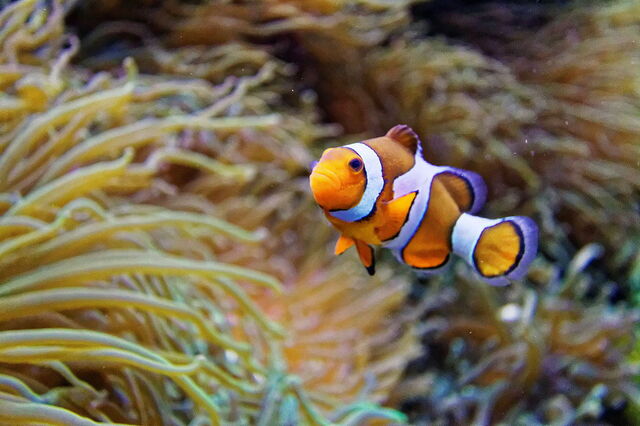
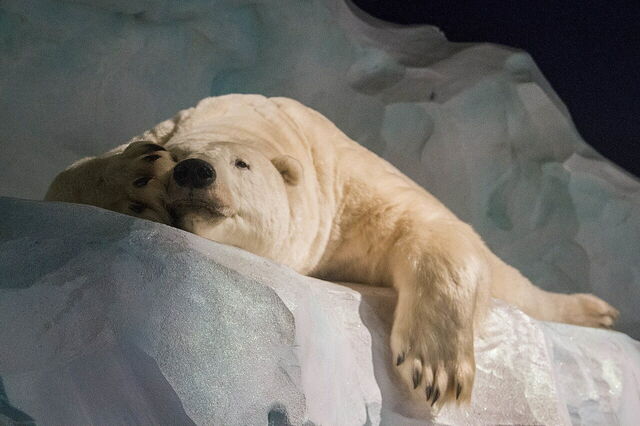
The Temperate pavilion hosts animals and plants from the Breton coast in environments reconstructed as closely as possible to reality. Here you can learn about tides, waves, and the formation of oceans and meet (and touch some) familiar flora and fauna in the demonstration pool such as starfish, anemones, sea urchins, seals, and local shark species. Meanwhile, in the Tropical pavilion, you will embark on a four-stage voyage across tropical seas, beginning at a tropical lagoon, passing through the Pacific Ocean and greeting sharks, discovering the coral reef of the Indo-Australian archipelago, viewing major families of colourful tropical fish from the Indian Ocean, exploring the Caribbean, and ending by walking through an equatorial forest. In the Polar pavilion, more adventure awaits with both the North and South poles represented, space to learn about the Inuit people of the Arctic, Arctic fauna to discover, seals hanging out on ice floes, and penguins and, even, polar bears hanging out. There is also a temporary exhibition space that hosts a new exhibition every two years, such as “Fabulous Sea Monsters,” and “Marine Mammals,” to further inform visitors about the sea and there is an outdoor space where various otters and sea lions from around the world are housed.
A bustling centre of research in France, a wonderful place to learn more about the oceans, and full of fascinating plants and both fearsome and lovely creatures, Océanopolis makes for an amazing day out for the whole family, enthusiasts, and curious minds alike who have found a villa in Brittany.
Océanopolis
Port de Plaisance du Moulin Blanc, 29200 Brest, France
+33 2 98 34 40 40
Tickets:
Adults €21.30
Young People €16.10
Children €13.50
A bustling centre of research in France, a wonderful place to learn more about the oceans, and full of fascinating plants and both fearsome and lovely creatures, Océanopolis makes for an amazing day out for the whole family, enthusiasts, and curious minds alike who have found a villa in Brittany.
Océanopolis
Port de Plaisance du Moulin Blanc, 29200 Brest, France
+33 2 98 34 40 40
Tickets:
Adults €21.30
Young People €16.10
Children €13.50
Photo credits:
Picture 1: Thesupermat / CC BY-SA 4.0;
Picture 2: Caroline Léna Becker / CC BY-SA 4.0
Picture 1: Thesupermat / CC BY-SA 4.0;
Picture 2: Caroline Léna Becker / CC BY-SA 4.0