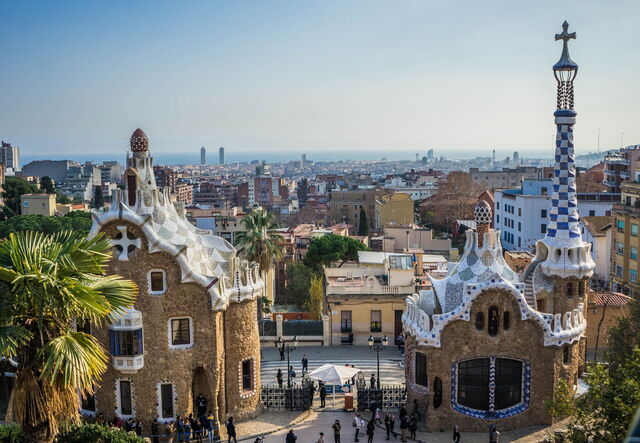
One of Barcelona's most popular attractions is Park Güell, a public park system composed of gardens and architectonic elements located on Carmel Hill that was designed by famous Catalonian architect Gaudí. Around four million people visit every year. In fact, it is such a key attraction in the city that it has come to symbolise the city itself and is an iconic visual that is plastered across all advertisements for and articles about Barcelona.
The idea for the park came about in 1900, when Count Eusebi Güell bought a hillside that was then located just outside Barcelona and hired the trendy Gaudí to create a miniature city of houses for the wealthy, set in landscaped grounds. However, the plans did not work out and as it was a commercial flop, it was abandoned and left incomplete in 1914. Yet, 3km of roads, walks, steps, a piazza and two gatehouses at the planned entrance remained as a reminder of what had been intended. Thankfully, this was not left to ruin or demolished but was, instead, bought by the city in 1922 and made into a public park.
Entrance today is via Carrer d’Olot, where the two distinctive gatehouses stand, just beyond is the park’s Centre d’Interpretaciò, in the Pavelló de Consergeria, a typically curvaceous and ornate Gaudí building that was formerly the porter’s home. Inside is an exhibition that gives a great outline on Gaudí’s building methods and the history of the park and, from the top, there are extraordinary views across Barcelona.
Other highlights of the park include the iconic mosaic lizard; the Sala Hipóstila (or Doric Temple) that is made up of an incredible forest of 88 stone columns and was originally intended as a market; the Banc de Trencadís, a tiled bench that curves around the park's perimeter and was designed by architect Josep Maria Jujol; the Casa-Museu Gaudí by Francesc Berenguer i Mestres, where Gaudí lived for the last 20 years of his life; and the excellent views from the cross-topped Turó del Calvari.
As noted, the park is extremely popular and only 400 people are admitted every half-hour, so it is advised to book ahead online but it is worth the forward planning as it is a must-see. Just find a vacation rental in Barcelona or vacation rental in Catalonia and drop by this incredible attraction in Spain.
Entrance today is via Carrer d’Olot, where the two distinctive gatehouses stand, just beyond is the park’s Centre d’Interpretaciò, in the Pavelló de Consergeria, a typically curvaceous and ornate Gaudí building that was formerly the porter’s home. Inside is an exhibition that gives a great outline on Gaudí’s building methods and the history of the park and, from the top, there are extraordinary views across Barcelona.
Other highlights of the park include the iconic mosaic lizard; the Sala Hipóstila (or Doric Temple) that is made up of an incredible forest of 88 stone columns and was originally intended as a market; the Banc de Trencadís, a tiled bench that curves around the park's perimeter and was designed by architect Josep Maria Jujol; the Casa-Museu Gaudí by Francesc Berenguer i Mestres, where Gaudí lived for the last 20 years of his life; and the excellent views from the cross-topped Turó del Calvari.
As noted, the park is extremely popular and only 400 people are admitted every half-hour, so it is advised to book ahead online but it is worth the forward planning as it is a must-see. Just find a vacation rental in Barcelona or vacation rental in Catalonia and drop by this incredible attraction in Spain.