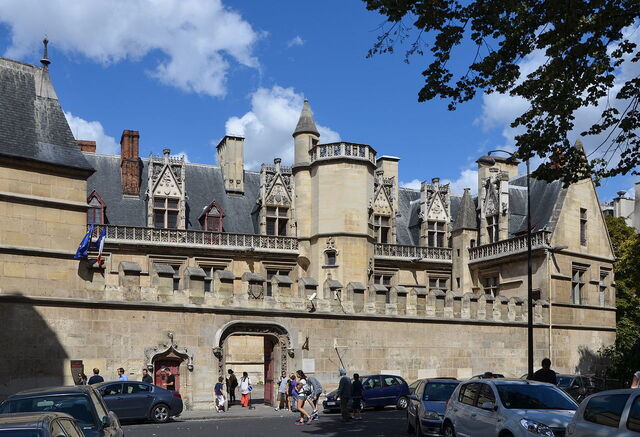
The Musée de Cluny, or Musée National du Moyen Âge, is a rather special museum that is located in one of the oldest buildings in Paris, a former townhouse that dates to the 14th century, with the foundation of 3rd century Gallo-Roman thermal baths beneath it.
The museum itself is dedicated to medieval life and is home to objects such as sculptures, graphic works, manuscripts, stained glass, and furniture and other decorative items.
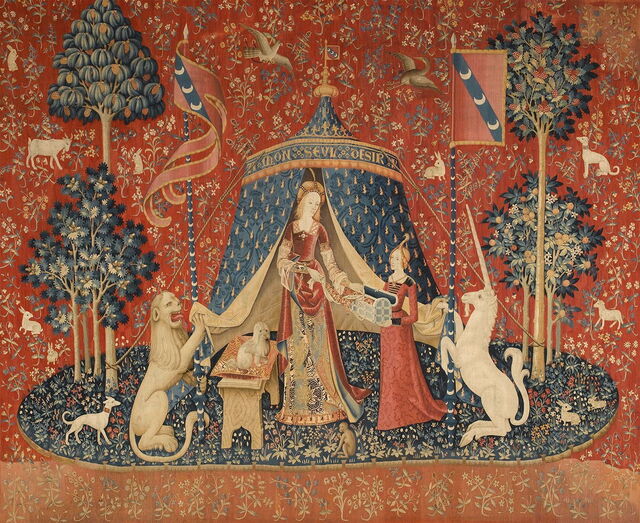
However, the most famous thing in its holdings are the iconic “The Lady and the Unicorn,” tapestries.
Founded in 1843 by the French State, the museum is made up of 23 rooms, all crammed to the gills with fascinating objects. These pieces are the focus, of course, but the museum is worth visiting for its pretty gardens and the building itself, which is a beautiful mansion in Gothic and Renaissance styles.
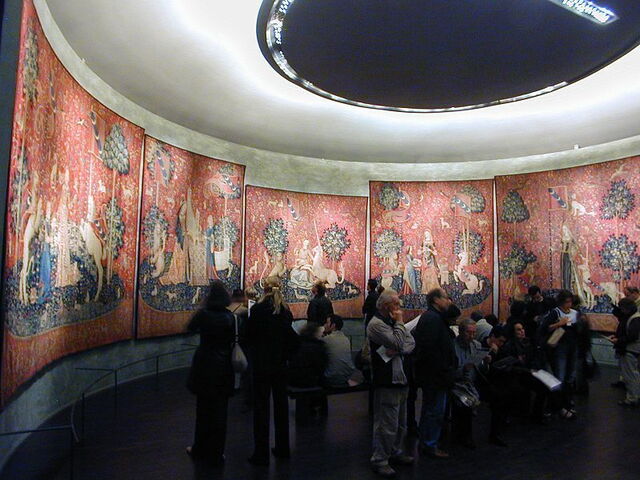
Then there are the tapestries. These beloved works are woven from wool and silk, and are a series of six tapestries.
The first five are based on the five senses, with a woman interacting with a unicorn, as well as a lion and, sometimes, a monkey. In the “sight” tapestry, she holds up a mirror for the unicorn who looks at it and in the “touch” tapestry, she has her hand on the unicorn’s horn.
The sixth tapestry, meanwhile, is more ambiguous. Its text reads “À Mon Seul Désir” (“To my only desire”), a phrase which is often interpreted as a declaration of independence or, perhaps, purity.
As a whole, the series has been interpreted many ways and remains somewhat mysterious but it is, undoubtedly a beautiful sight to behold, expressed in rich tones with elaborate backgrounds filled with woodland creatures, plants and flowers, creating an enchanted landscape.
If you are an art lover who has found a vacation rental in Paris and you're looking to go beyond the Musee D'Orsay or the Louvre, this is one of the lesser-known and less flashy museums but has plenty of charms of its own and is home to one of the most celebrated works in European art.
Photo credits
picture 2: Atlant / CC BY 2.5;
picture 3: Pline / CC BY-SA 3.0
picture 2: Atlant / CC BY 2.5;
picture 3: Pline / CC BY-SA 3.0