Brač is a famously beautiful Croatian island in the Adriatic, that is part of the Split-Dalmatia region and the biggest island in Dalmatia. It is best-known for Zlatni Rat (the Golden Cape), a stunning white-pebble beach outside the resort town of Bol that is a popular windsurfing spot, and for the striking horseshoe-shaped beach that is located by the island's main town, Supetar. With its distinct and varied coast with numerous gullies, crevices, cavities, round valleys, coves, and famously lovely beaches and its lush inland landscape, it is a place of great and singular natural beauty.
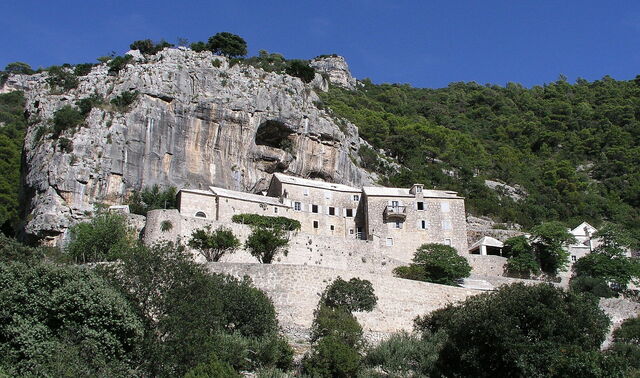
However, that is not all there is to the island. As a major site for quarrying stone since antiquity, it makes sense that the island is also home to some incredible works of manmade beauty too. Pretty traditional villages are to be found on the island, with the seaside village of Pučišća being especially noteworthy. However, the most famous architectural gem on Brač is likely the beautiful hermitage of Pustinja Blaca. One of several hermitages on the island, Pustinja Blaca is made from the glittering white limestone for which Brač is well-known and is set into a romantically craggy cliffside. A rather extraordinary sight to behold, it is a must-see for those who have found a vacation rental in Split and plan on taking the ferry over to explore Brač for the day.
However, that is not all there is to the island. As a major site for quarrying stone since antiquity, it makes sense that the island is also home to some incredible works of manmade beauty too. Pretty traditional villages are to be found on the island, with the seaside village of Pučišća being especially noteworthy. However, the most famous architectural gem on Brač is likely the beautiful hermitage of Pustinja Blaca. One of several hermitages on the island, Pustinja Blaca is made from the glittering white limestone for which Brač is well-known and is set into a romantically craggy cliffside. A rather extraordinary sight to behold, it is a must-see for those who have found a vacation rental in Split and plan on taking the ferry over to explore Brač for the day.
Located in the eastern corner of a rocky valley to the south of the island, between the towns of Bol and Milna, Pustinja Blaca was established in 1551 by two Glagolitic monks from Poljica who had come to the area as they fled Turkish forces. The men were offered protection and shelter in a nearby cave called Ljubitovica by the people of Bol and later received a certificate of ownership of the land and founded a monastery on the site that had once safeguarded them in a time of danger. They built a church surrounding the very cave in which they had hidden and a monastic complex followed suit over time.
For over 400 years the monastery was run by successive generations of monks until 1963 and the death of the last of the monks, Father Niko Miličević. The hermitage was not only a monastery and an incredibly religious place but has also been a farm, school, and a private astronomical observatory and was home to a printing press throughout the centuries. The monks were involved in the production of wine (turning out thousands of litres), had hundreds of olive trees and made their own olive oil, kept sheep, oxen and mules, and had their own bee hives that produced 3,000 kilograms of honey per year.
Today the monastery is open to the public as a museum with lots of fascinating artefacts, including some 11,000 books in the monastery library, many of which are written in the Glagolitic monks, paintings, armour, period furniture, old clocks, a 400kg piano, and a rather impressive telescope, all of which is best seen by taking the guided tour of the monastery that is offered at a small fee. Head by car Nerežišća over Vidova Gora to Dragovoda and then walk about 30 minutes up to the monastery or undertake the relatively challenging 2km hike from the bay below to really get a sense of the monastic lifestyle of times past and then explore this rather special gem that is on the UNESCO World Heritage Site Tentative List. Just another reason to pencil in a visit to the stunning island of Brač if you have found a holiday rental in Split and are looking for some day trip ideas in Croatia.
For over 400 years the monastery was run by successive generations of monks until 1963 and the death of the last of the monks, Father Niko Miličević. The hermitage was not only a monastery and an incredibly religious place but has also been a farm, school, and a private astronomical observatory and was home to a printing press throughout the centuries. The monks were involved in the production of wine (turning out thousands of litres), had hundreds of olive trees and made their own olive oil, kept sheep, oxen and mules, and had their own bee hives that produced 3,000 kilograms of honey per year.
Today the monastery is open to the public as a museum with lots of fascinating artefacts, including some 11,000 books in the monastery library, many of which are written in the Glagolitic monks, paintings, armour, period furniture, old clocks, a 400kg piano, and a rather impressive telescope, all of which is best seen by taking the guided tour of the monastery that is offered at a small fee. Head by car Nerežišća over Vidova Gora to Dragovoda and then walk about 30 minutes up to the monastery or undertake the relatively challenging 2km hike from the bay below to really get a sense of the monastic lifestyle of times past and then explore this rather special gem that is on the UNESCO World Heritage Site Tentative List. Just another reason to pencil in a visit to the stunning island of Brač if you have found a holiday rental in Split and are looking for some day trip ideas in Croatia.
Photo credits: Pustinja Blaca / CC BY 2.5