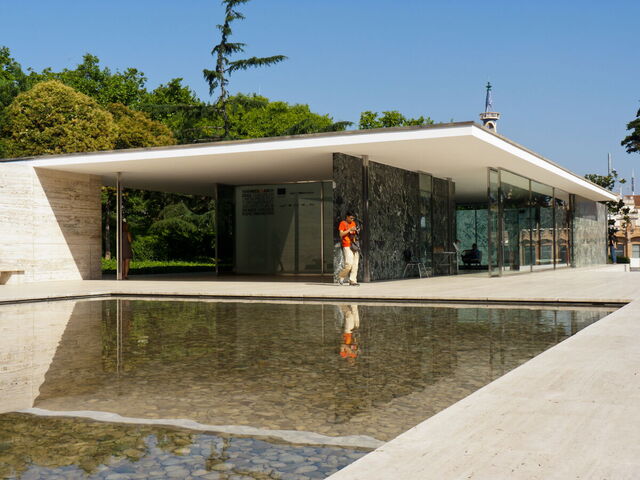
Those who love architecture will not need to be told that a vacation rental in Barcelona and time spent exploring all that the city has to offer is a must at some point in your life, a major item to tick off the bucket list. And, of course, traces of Gaudi can famously be found all over the city. However, his are not the only architectural gems to be discovered while on holiday in Catalonia. There are many others, some dating back hundreds and hundreds of years and some much more recent additions. However, if you have an interest in architecture and you plan on coming to see Barcelona, then one of the key attractions to make sure you set aside some time for is Ludwig Mies Van der Rohe and Lilly Reich’s Barcelona Pavilion.
Also known as the German Pavilion, the Barcelona Pavilion was originally Mies Van der Rohe and Reich’s submission as the German entry to the 1929 International Exposition in Barcelona. Mies Van der Rohe was a German-American architect of incredible importance in the 20th century who was considered one of the pioneers of modernist architecture and has been a highly influential figure in architecture through his own work and his time as head of the architecture school at what is today the Illinois Institute of Technology in Chicago. Reich, meanwhile, was also an integral figure in modern design and architecture who worked with Mies Van der Rohe for over a decade between the late 1920s and 1930s. One of their most famous collaborations, the Barcelona Pavilion was a stunning combination of simple forms and exceptionally beautiful and extravagant materials that made use of the free (or open) plan and floating roof principles of modern architecture. A representation of how Germany was recovering post-WWI as the new Weimar Germany, it was a striking and note-worthy addition to the International Exposition.
The building was, however, always intended to only be temporary as part of the showcase and, in 1930, it was torn down. Despite the fact that the building originally only survived for less than a year, it was eventually reborn and recreated. Between 1983 and 1986, a group of Catalan architects banded together and used historical drawings and rediscovered footings on the site to rebuild the pavilion permanently. Since then, it has been a popular tourist attraction and one of the key architectural tourist attractions in the city. It is, however, a somewhat controversial site among architects, critics, and historians with some saying it is a revived masterpiece and others claiming it to be a fake. The American architecture critic Paul Goldberger has even said of it that it, “is not supposed to exist.” Others are more ambivalent to its existence, meanwhile. Despite all this, it does now exist and it is, indeed, a popular spot for tourists to visit. While there may be some discrepancies and the recreation does remove the building from its original sociopolitical context, many are glad to be able to see the beauty of this collaboration of two incredible designers and architects in its totality and it is an interesting thing to witness and experience in person no matter where you land on the debate. Certainly, for those uninterested in academic and philosophical debate but who are fans of the work of these greats, it shouldn’t be missed.
So, if you have an interest in architecture and design and have found a holiday rental in Barcelona then be sure to plan a visit this special gem while exploring the architectural history and culture of the city. It is definitely one of the most fascinating buildings in Spain.