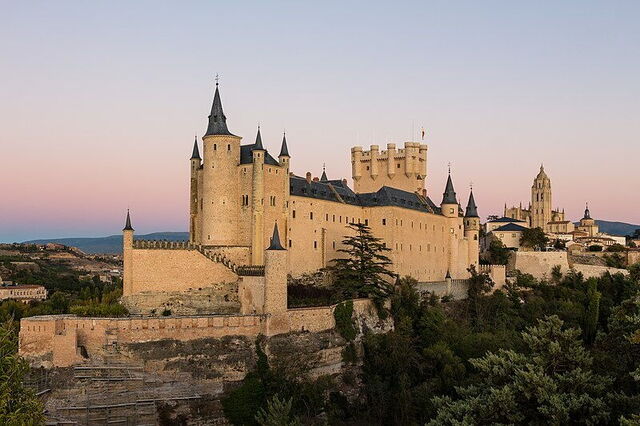
When one thinks of the fairytale castles that inspired the illustrations that we all grew up with in storybooks and cartoons and in Disneyland, the buildings romantically perched over lush valleys of Germany and the ornate chateaux of France are probably what springs to mind. No doubt, if you are interested in bringing a little bit of magic into your life and seeking out such incredible architectural gems IRL, these are two excellent destinations in which to do so. However, did you know that one of the most influential castles to inspire the likes of Disney is actually in Spain?
Located in the town of Segovia, northwest of Madrid and an excellent day trip destination for those who find a holiday rental in Madrid, the Alcázar de Segovia is quite the sight to behold. A massive cream castle punctuated by little arched windows, a castellated tower, and several charming pointed turrets, it is the quintessential sort of fairytale, picture-perfect palace that many might imagine when conjuring such things. It is no wonder, then, that it was used as a model for the design of the queen's castle in Disney's Snow White and the Seven Dwarfs (1937) and for Cinderella's castle as imagined in Walt Disney World and Tokyo Disneyland.
Located in the town of Segovia, northwest of Madrid and an excellent day trip destination for those who find a holiday rental in Madrid, the Alcázar de Segovia is quite the sight to behold. A massive cream castle punctuated by little arched windows, a castellated tower, and several charming pointed turrets, it is the quintessential sort of fairytale, picture-perfect palace that many might imagine when conjuring such things. It is no wonder, then, that it was used as a model for the design of the queen's castle in Disney's Snow White and the Seven Dwarfs (1937) and for Cinderella's castle as imagined in Walt Disney World and Tokyo Disneyland.
One of the three main landmarks of Segovia's stunning and UNESCO-awarded historic city centre (along with the Cathedral and the midtown Roman aqueduct), the Alcázar de Segovia is also on UNESCO's World Heritage List and is a medieval architectural gem. Predated on the site by a Roman fort, the origins of the current building can be traced to the Berber Almoravid dynasty when a fort was built and then turned into a royal palace by the Muslim rulers of the time. Most of this earlier building was replaced by the present structure which was built after King Alfonso VI reconquered lands in the area. The first reference that we have in writing to the castle dates to 1120, around 32 years after Segovia came back under Christian rule.
A favoured residence of monarchs throughout the Middle Ages and an important defensive structure for the defence of the kingdom, the castle was gradually added to and expanded by later rulers. However, the royal court eventually shifted to Madrid and the castle was used as a prison for close to two centuries before it was made into the Royal Artillery School by King Charles III in 1762. A fire badly damaged the roof in 1862 and restoration took some time thereafter. In 1896, King Alfonso XIII gave the building to the Ministry of War and it became a military college. Today, it is open to the public as a museum and houses an important archive of military materials. The luxuriously decorated interiors, fascinating irregular plan that follows the shape of the hill on which it is built, and those cinematic exteriors are not to be missed! Admire the whole as well as the Herrerian courtyard, moat, drawbridge and other details while approaching and wandering around the building and then, if you pay to enter, you can explore interior rooms such as the chapel and rooms such as del Trono, de la Galera, de las Piñas, de los Reyes, and others that are open for visits.
A must for lovers of history, art, and architecture, and those wishing to bring a bit of magic into their daily lives, be sure to plan a trip if you have browsed our villas in Spain and plan on spending time in a vacation rental in Madrid!
Alcázar de Segovia
Plaza la Reina Victoria Eugenia
Segovia, 40003
Spain
+34 921 46 07 59
Opening hours:
Winter time - From November 1 to March 31: Daily, 10am to 6pm
Summer - From April 1 to October 31: Daily, 10am to 8pm
Closed Christmas Day, 1st of January, 6th of January.
Tickets: €9 (for access to the castle, museum, and Tower of Juan II)
Photo credit: Rafa Esteve / CC BY-SA 4.0