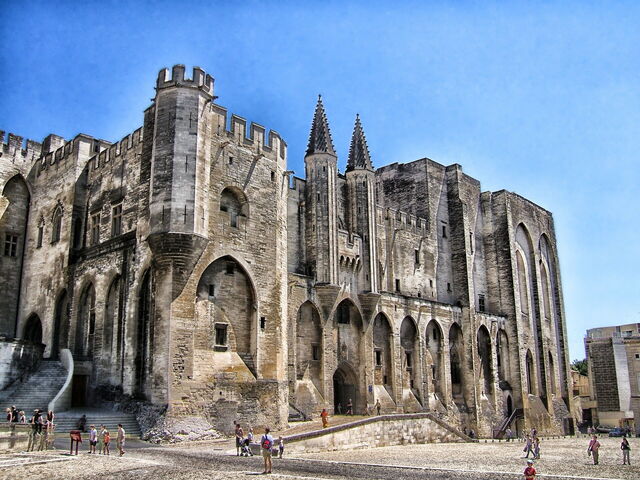
Provence, as a region, is full of incredibly beautiful sights from endless lavender fields, to ancient monasteries, to stunning beaches, to perfectly pretty medieval towns full of architectural gems. If you have found a vacation rental in Provence and are exploring the region and you are looking for particularly lovely examples of the latter, we recommend a visit to the gorgeous town of Avignon in France and to the Palais des Papes.
In 1305, Clement V was elected as Pope and famously made the decision to transfer papal power to Avignon in order to avoid the political unrest of Rome at the time. With this move, a new home for the papal seat was required and the largest medieval gothic palace in the world was built upon the foundations of an old Episcopal bishop's palace. This building, though begun under Clement V was greatly expanded under Benedict XII in 1334 and then even further under Clement VI in 1342 when he joined Benedict XII's Palais Vieux (Old Palace) and the Palais Neuf (New Palace). All of these extensions and this expansion eventually added up to create the monumental gem full of incredible objects and a rich and complex history that we know today; it covers a whopping 15,000 square metres, boasts ten fortified towers, was home to Europe's largest library at the time, excellent frescoes and fresco cycles, and much more besides.
In 1305, Clement V was elected as Pope and famously made the decision to transfer papal power to Avignon in order to avoid the political unrest of Rome at the time. With this move, a new home for the papal seat was required and the largest medieval gothic palace in the world was built upon the foundations of an old Episcopal bishop's palace. This building, though begun under Clement V was greatly expanded under Benedict XII in 1334 and then even further under Clement VI in 1342 when he joined Benedict XII's Palais Vieux (Old Palace) and the Palais Neuf (New Palace). All of these extensions and this expansion eventually added up to create the monumental gem full of incredible objects and a rich and complex history that we know today; it covers a whopping 15,000 square metres, boasts ten fortified towers, was home to Europe's largest library at the time, excellent frescoes and fresco cycles, and much more besides.
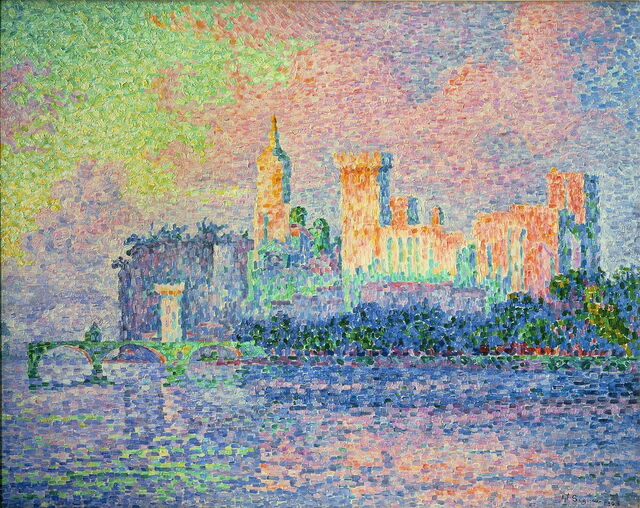
While many successive Popes focused on the building and expanding of the Palais des Papes in Avignon, the ultimate goal always was to return to Rome. In 1376, Grégoire XI took control of Rome and re-established the Holy See in the city. However, upon his death in 1378, the Avignon seat of papal power was reaffirmed and there was both a pope elected in Rome (Urban VI) and in France (Clement VII). Avignon's Palais des Papes, therefore, became a symbol of the deep divide that had developed in the Catholic Church. In 1394 Benedict XIII took power and attacked Avignon. They managed to withstand two sieges before conceding to Benedict's rule and power was finally transferred completely back to Rome.
In the following centuries, the Church maintained control of the palace and it was used to house travelling dignitaries, slowly falling into disrepair all the while. During the French Revolution it was seized from the Church and suffered further damages. Next, it was used by Napoleonic forces as a barracks and stables, which understandably lead to even more damage to the building, with the frescoes, in particular, suffering during this time. Thankfully, in the 20th century, it was returned to the state and repairs were begun. In fact, it has remained constantly under restoration since then.
In the following centuries, the Church maintained control of the palace and it was used to house travelling dignitaries, slowly falling into disrepair all the while. During the French Revolution it was seized from the Church and suffered further damages. Next, it was used by Napoleonic forces as a barracks and stables, which understandably lead to even more damage to the building, with the frescoes, in particular, suffering during this time. Thankfully, in the 20th century, it was returned to the state and repairs were begun. In fact, it has remained constantly under restoration since then.

One of the most beloved and best-known monuments in France, a UNESCO-awarded beauty, and a national tourist attraction that draws 650,000 visitors per year, putting it in the top ten monuments in terms of numbers in the country, the Palais des Papes became a national museum back in 1906 and has been open to the public at large since then. It is both an attraction in its own right for its architectural merit, mind-blowing scale, incredible grandeur, and the beautiful objects that are housed inside the palace and as a venue that has played host to some amazing events and exhibitions. In fact, it has a particularly strong tradition in host excellent temporary art exhibitions and has showcased the works of Picasso, Matisse, Braque, Mondrian, Miquel Barceló, and Stefan Szczesny in thematic curations and single exhibitions throughout the years. If you have found a vacation rental in Provence and are exploring this part of France, it is a definitive must-see attraction.
Photo credits
Picture 3: Chimigi / CC BY-SA 2.0
Picture 3: Chimigi / CC BY-SA 2.0