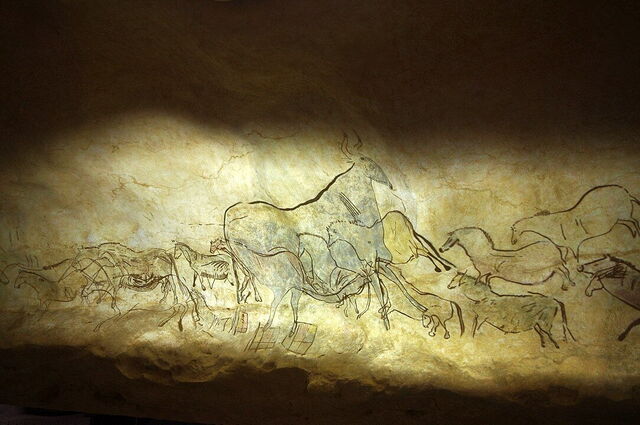
If you are visiting France, you will no doubt end up going to see a historical monument or two during your holiday and there are lots of incredible gems from the rich and complex past of the nation that are located all over the country. From the castles of the Loire Valley, to the stunning cathedrals dotted throughout the cities of France, from impossibly famous monuments like the Eiffel Tower and Arc de Triomphe to the Catacombs beneath Paris, from Roman aqueducts to whole preserved towns bombed during WWII, there are all sorts of incredible historical attractions to visit in France. However, if you are slightly more interested in a time further back, in prehistory, then you are also in luck. Lascaux Cave, or the Grotte de Lascaux, is a complex of caves near the village of Montignac that is covered in prehistoric drawings. While the original caves themselves cannot actually be visited anymore due to their deteriorating condition, there are full-scale replicas located in museums nearby that visitors can go to observe. So, if you have found a vacation rental in Montignac be sure to go and check them out!
On the 12th of September in 1940, an 18-year-old local boy named Marcel Ravidat was out walking with his dog, Robot. When the dog fell into a hole, Marcel ran home and found three of his friends, Jacques Marsal, Georges Agnel, and Simon Coencas, to help him try and rescue Robot. In following the dog, they went into a 15-metre-deep hole that led into, and to the discovery of, the Lascaux Cave. Previously thought to have been a legendary secret passage that would lead to the Lascaux Manor nearby, the boys quickly realised that it was something entirely different when they saw giant depictions of animals painted on the walls of the caves all around them.
The boys eventually returned to the caves once more with the Abbé Henri Breuil, Denis Peyrony (curator of the Prehistory Museum at Les Eyzies), Jean Bouyssonie, and Dr Cheynier on the 21st of September and, luckily, Breuil made extensive sketches of the wall paintings which have suffered greatly from fungal growth and decay since their discovery. These sketches remain an important resource and document in the study of the caves and paintings. It was, in fact, the opening of the cave complex to the public in July 1948 and the introduction of archaeological teams to begin initial study and investigation of the area in 1949 that signalled danger for the paintings as the 1,200 daily visitors that had descended upon the caves by 1955 led to vast amounts of damaging carbon dioxide, heat, humidity, and other contaminants being introduced to the space. The air condition of the space worsened, as a result, and lichen and fungi began to infest the walls and paintings at an alarming rate. It was decided to close the caves to the public in 1963, and the paintings were then restored and a monitoring system was put in place.
Never fear, though, as there is still an easy way to go and see the paintings and to learn all about them so be sure to read on to the second part in this series on Lascaux where we will discuss: the history of the caves, the content of the paintings, how they were made, the museum dedicated to them, and more. If you have found a vacation rental in Montignac or a vacation rental in France then be sure to come and discover more about this truly fascinating ancient artistic and historic gem for yourself! All of this is also particularly relevant at the moment, too, as the 80th anniversary of the discovery of the caves has recently just gone by and there are special events and exhibitions taking place as a result, including the introduction of the, “Emotion of the Discover,” 4.5km-long walking loop that follows the path taken by the four young discoverers of the caves.
The boys eventually returned to the caves once more with the Abbé Henri Breuil, Denis Peyrony (curator of the Prehistory Museum at Les Eyzies), Jean Bouyssonie, and Dr Cheynier on the 21st of September and, luckily, Breuil made extensive sketches of the wall paintings which have suffered greatly from fungal growth and decay since their discovery. These sketches remain an important resource and document in the study of the caves and paintings. It was, in fact, the opening of the cave complex to the public in July 1948 and the introduction of archaeological teams to begin initial study and investigation of the area in 1949 that signalled danger for the paintings as the 1,200 daily visitors that had descended upon the caves by 1955 led to vast amounts of damaging carbon dioxide, heat, humidity, and other contaminants being introduced to the space. The air condition of the space worsened, as a result, and lichen and fungi began to infest the walls and paintings at an alarming rate. It was decided to close the caves to the public in 1963, and the paintings were then restored and a monitoring system was put in place.
Never fear, though, as there is still an easy way to go and see the paintings and to learn all about them so be sure to read on to the second part in this series on Lascaux where we will discuss: the history of the caves, the content of the paintings, how they were made, the museum dedicated to them, and more. If you have found a vacation rental in Montignac or a vacation rental in France then be sure to come and discover more about this truly fascinating ancient artistic and historic gem for yourself! All of this is also particularly relevant at the moment, too, as the 80th anniversary of the discovery of the caves has recently just gone by and there are special events and exhibitions taking place as a result, including the introduction of the, “Emotion of the Discover,” 4.5km-long walking loop that follows the path taken by the four young discoverers of the caves.