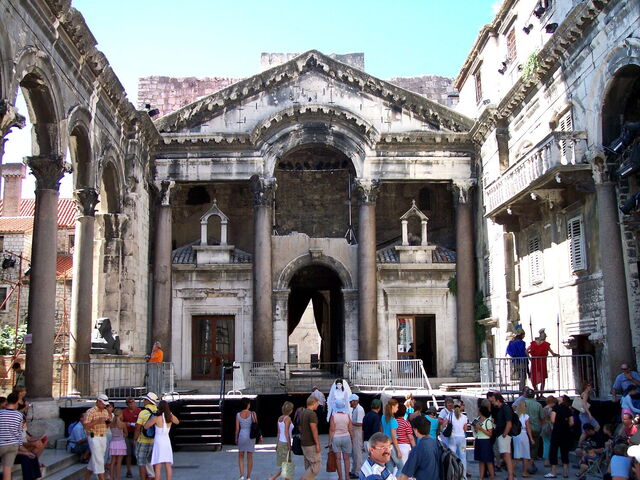
Once you have found a vacation rental in Split, there is one attraction in the city that is bound to top your list: Diocletian’s Palace. One of the most imposing and important of all Roman ruins, it is the site where Emperor Diocletian, who had voluntarily given up the throne of the Roman Empire in the 4th century, retired.
He built his palace on the beach, in the Illyrian province of Rome, which would later become a part of modern-day Croatia. The whole complex occupied around 30,000 square meters and included the domestic “palace” as well as other buildings, including a military garrison.
These buildings have all become intertwined with the centre of the city and now makes up the Old Town of Split. Shops, cafes, restaurants and apartments housing around 3000 people now exist where the palace once stood alone.
He built his palace on the beach, in the Illyrian province of Rome, which would later become a part of modern-day Croatia. The whole complex occupied around 30,000 square meters and included the domestic “palace” as well as other buildings, including a military garrison.
These buildings have all become intertwined with the centre of the city and now makes up the Old Town of Split. Shops, cafes, restaurants and apartments housing around 3000 people now exist where the palace once stood alone.
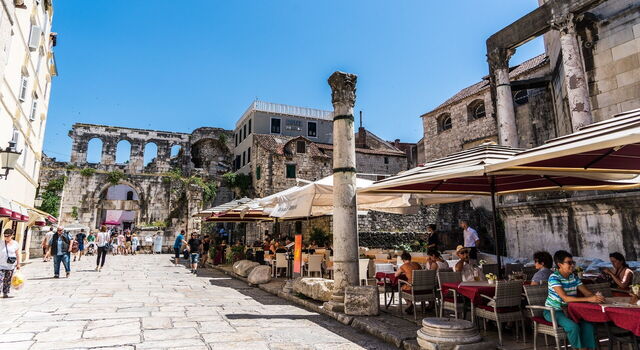
Not much is left from the era of Diocletian today, just the palaces and the remains of some walls and gates. The old city is now dotted with white stone buildings from a variety of different periods and expressed in a range of different styles.
The palace, meanwhile, is on an irregular rectangle plan, with a number of towers on the western, northern, and eastern facades, and is a mixture of villa and castrum architecture.
What survives today are some of the lower floors of Diocletian's apartments, his octagonal mausoleum, one of three original temples that was later turned into a baptistery and the Peristyle.
The palace, meanwhile, is on an irregular rectangle plan, with a number of towers on the western, northern, and eastern facades, and is a mixture of villa and castrum architecture.
What survives today are some of the lower floors of Diocletian's apartments, his octagonal mausoleum, one of three original temples that was later turned into a baptistery and the Peristyle.
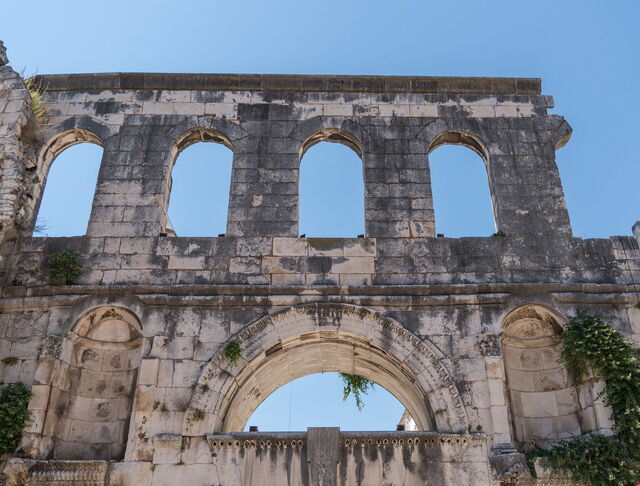
What is most interesting – aside from the remnants of Diocletian's once magnificent palace, marbles from Egypt, Rome and Greece and surviving antiques – is how the ruins have become so intimately tied to the city. Unlike many other ruins around the world, there is no ghostly or abandoned atmosphere but, instead, a sense that the place is still flush with life. Children play in the narrow streets, tourists bustle, laundry is hung out to catch the sea breeze and music floats through the air.
Much as these ruins are fascinating from a historical perspective and what once was is beautiful, the organic assumption of the palace into the city over the years is just as lovely and worth visiting in its own right if you are exploring Croatia.
Much as these ruins are fascinating from a historical perspective and what once was is beautiful, the organic assumption of the palace into the city over the years is just as lovely and worth visiting in its own right if you are exploring Croatia.