
The monastery of Hosios Loukas lies is located in a scenic position on the western slope of Mt. Helikon, below the acropolis of ancient Steirion and is a beautiful complex comprised of several buildings. It is home to some extraordinary mosaics and works of art, as well as the architectural gems that are the buildings themselves. A UNESCO site as part of the group called, “Monasteries of Daphni, Hosios Loukasand Nea Moni of Chios” since 1990, it is a historic walled monastery and one of the most important monuments of Middle Byzantine architecture and art.
Certainly, it is the largest of the only three surviving monasteries from this period in Greece. Located near the town of Distomo, in Boeotia, it is a must-see for those who have found vacation rentals in Central Greece as it is a beautiful Byzantine jewel box, set within an architectural gem, surrounded by natural beauty.
Certainly, it is the largest of the only three surviving monasteries from this period in Greece. Located near the town of Distomo, in Boeotia, it is a must-see for those who have found vacation rentals in Central Greece as it is a beautiful Byzantine jewel box, set within an architectural gem, surrounded by natural beauty.
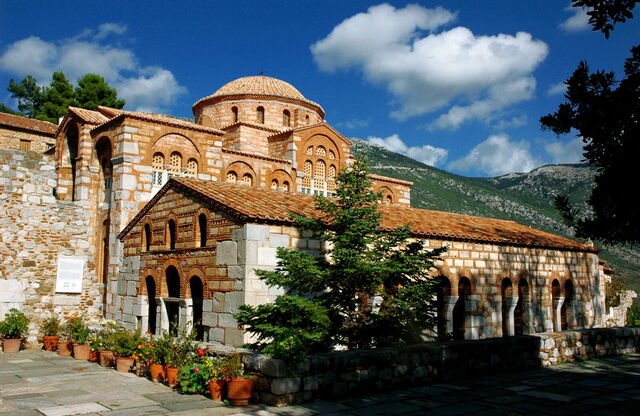
Founded in the early 10th century AD by the hermit, Venerable (Hosios in Greek) St. Luke (Lukas) the monastery remains home to his relics. The complex is made up of the Church of the Theotokos (the only church known with certainty to have been built in mainland Greece in the tenth century), a larger cathedral church, or Katholikon that is tentatively dated to 1011-12 and other buildings.
The smaller church is dedicated to the Theotocos and boasts walls built in cloisonne masonry and decorated with rich brick (Cufic) ornaments; rich sculptural decoration on the templon, the capitals and dome; beautiful wall paintings from the 11th to the 12th centuries and traces of earlier frescos: among these is the famous fresco of Jesus of Navi that was discovered in 1965, dates to the 10th century and was originally located on the facade of the church but was later covered by marble slabs when the wall became part of the interior.
The smaller church is dedicated to the Theotocos and boasts walls built in cloisonne masonry and decorated with rich brick (Cufic) ornaments; rich sculptural decoration on the templon, the capitals and dome; beautiful wall paintings from the 11th to the 12th centuries and traces of earlier frescos: among these is the famous fresco of Jesus of Navi that was discovered in 1965, dates to the 10th century and was originally located on the facade of the church but was later covered by marble slabs when the wall became part of the interior.
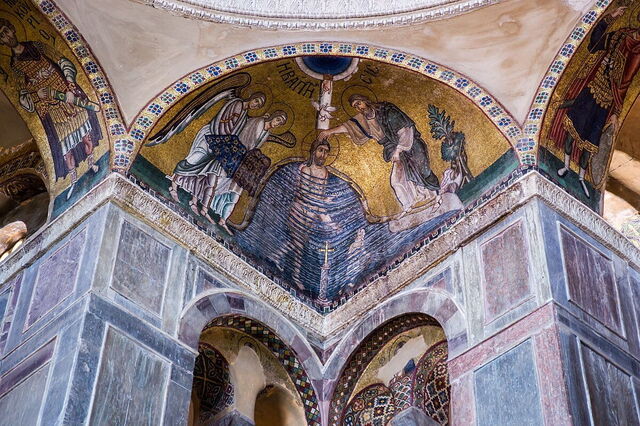
The Katholikon is the earliest extant domed-octagon church and was built in the first half of the 11th century. Its walls are veneered with marble slabs on the lower section and decorated with superb Byzantine mosaics on the upper register, most of which date to the first half of the 11th century, while the Pantocrator and Archangels in the dome belong to a later phase. These mosaics, glittering and gilded and in that distinctive abstracted Middle Byzantine style, are the most famous and fantastic parts of the entire complex.
For mosaics that compete in beauty with Ravenna, if not in fame, make sure to stop by this gem of a building in Greece.
For mosaics that compete in beauty with Ravenna, if not in fame, make sure to stop by this gem of a building in Greece.
Photo credits
picture 1: Evangelos Karpathakis / CC BY-SA 4.0;
picture 2: G Da / CC BY-SA 3.0
picture 1: Evangelos Karpathakis / CC BY-SA 4.0;
picture 2: G Da / CC BY-SA 3.0