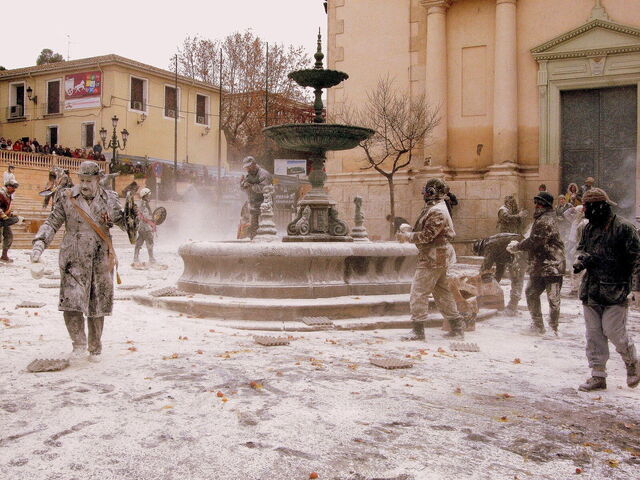
The Els Enfarinats Festival is another of Spain's wonderful traditions and another example of an annual large-scale European food fight, just like the Spanish La Tomatina fight with tomatoes and the Italian Battle of the Oranges. This festival, however, takes place in the Spanish town of Ibi and employs flour bombs and eggs, instead of oranges.
Taking place on the 28th of December each year, it sees residents of the town dress in military garb, separate into two teams, and throw flour, eggs, and fire extinguisher dust at each other. It also escalates an hour later and firecrackers are involved in the fight, as well. If you're looking for an exciting post-festive season getaway, this is just the thing! Just find a vacation rental in Valencia and head to the town of Ibi, but make sure to bring a spare set of clothes.
Taking place on the 28th of December each year, it sees residents of the town dress in military garb, separate into two teams, and throw flour, eggs, and fire extinguisher dust at each other. It also escalates an hour later and firecrackers are involved in the fight, as well. If you're looking for an exciting post-festive season getaway, this is just the thing! Just find a vacation rental in Valencia and head to the town of Ibi, but make sure to bring a spare set of clothes.
“Els Enfarinats,” is actually the name of one of the two teams that take part and roughly translates to, “the floured ones,”. This team plays out an imaginary scenario in which they try to “take over the town.” They establish new and ridiculous laws and fine any “offenders”. This gathered money is then donated to charity after the event. The other team is “La Oposicio,” or, “The Opposition”, then fights back with the aforementioned flour bombs, eggs, and fire extinguisher dust. After the first hour of the fight, firecrackers come into play, giving anyone who might want to take part but avoid them, a chance to play along for a while.
The tradition dates back around 200 years but was resurrected in 1981 and lasts for several hours, using more than 1,500 eggs and hundreds of kilograms of flour. Afterwards, a large-scale clean-up begins and normality resumes in the town. Bizarre, fun and rather unusual, this special festival is an event that the curious traveller will find fascinating!
The tradition dates back around 200 years but was resurrected in 1981 and lasts for several hours, using more than 1,500 eggs and hundreds of kilograms of flour. Afterwards, a large-scale clean-up begins and normality resumes in the town. Bizarre, fun and rather unusual, this special festival is an event that the curious traveller will find fascinating!
Photo credit: Fotógrafo Ibi - Fotógrafo Ibi / CC BY-SA 4.0