The town of Enciso is a tiny little gem, a historic and utterly picturesque little village with a permanent population of only around one hundred people, in the southern part of La Rioja in Spain. Little though it may be, it is, however, rather famous for some former occupants from a long, long time ago....dinosaurs!
You might not expect it but this tiny village, that you have likely never even heard of and that is very much off the regular beaten path for tourists, is actually a great place for dinosaur-lovers to come and see traces of those magnificent beasts from around 120 million years ago.
It was during this period in pre-history that this part of Spain was actually a swamp with a mild climate and incredibly dense vegetation. The dinosaurs that roamed the landscape in the area and walked the swampy lands had their footprints immortalised in stone due to the unique and perfect environment for preservation that existed there.
You might not expect it but this tiny village, that you have likely never even heard of and that is very much off the regular beaten path for tourists, is actually a great place for dinosaur-lovers to come and see traces of those magnificent beasts from around 120 million years ago.
It was during this period in pre-history that this part of Spain was actually a swamp with a mild climate and incredibly dense vegetation. The dinosaurs that roamed the landscape in the area and walked the swampy lands had their footprints immortalised in stone due to the unique and perfect environment for preservation that existed there.
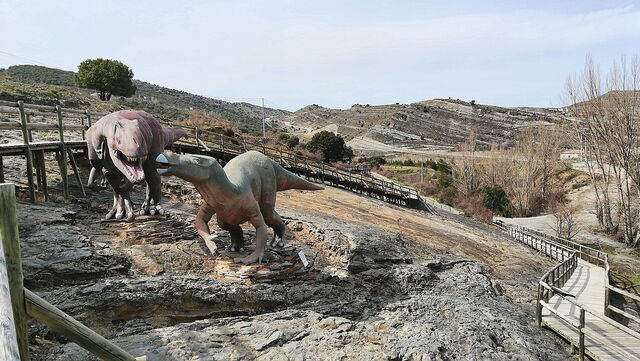
Enciso is situated in one of the areas with the most preserved dinosaur footprints that have been found and documented in the entire globe and the region around it is home to around 130 different sites and over 11,000 ichnites, or fossilised footprints, from sauropods, iguanodons, and various other species. The town itself is home to seven different sites with ichnites, including that of La Virgen del Campo, an outcrop in the area around the village that boasts some 500 footprints, as well as marks from skin, from tails dragging, from scratching, from a dinosaur swimming against the current and hitting the sediment with its claws, from two dinosaurs fighting, and from an earthquake. There is also a large sculpture that brings to life a recreation of the fight suggested by the marks from the aforementioned two dinosaurs.
Another site in the area surrounding Enciso is the Valdecillo deposit, in which there are fossils that suggest carnivorous dinosaurs measuring between seven to ten metres long, with feet ending in powerful claws, once occupied this area. There is also an area with a group of iguanodon prints that suggest a family with two adult prints and one juvenile set and, additionally, there are 59 tracks left by a sauropod. These groups are also accompanied by life-size sculptural representations of a Tarbosaurus, a family of herbivores with two adults and one baby, and a Brachiosaurus that measures 23m in length.
The other main site surrounding the town is the Villar-Poyales deposit, where the most unique and intriguing discovery took place; twenty footprints that have been attributed to a species first discovered in Enciso. This herbivorous bipedal species has been named the Theroplantigrada escisensis, in honour of the town in which it was uncovered. Interestingly, palaeontologists have been able to infer from the traces of this creature that it had an interdigital membrane, suggesting a special adaptation to an aquatic landscape and that, unlike most other dinosaurs, it used its whole sole while talking instead of just its toes.
Enciso is surrounded by a beautiful landscape that is popular among hikers and these dinosaur sites have lead to the development of a very special kind of trail that takes in visits to the various discoveries along the way. For outdoorsy types and those interested in a palaeontological adventure, this is a dream combo! However, most people can probably appreciate the ghostly traces of these long-lost astounding beasts, no matter their particular interests, and any children in a party of visitors are likely to be mesmerised by the giant dinosaur sculptures that can be spotted emerging from the landscape in the area. If you ever find yourself in this part of Spain, be sure to head to the Palaeontological Centre and the museum there and then explore the various sites and admire the remnants of these impressive and fascinating beasts.
Another site in the area surrounding Enciso is the Valdecillo deposit, in which there are fossils that suggest carnivorous dinosaurs measuring between seven to ten metres long, with feet ending in powerful claws, once occupied this area. There is also an area with a group of iguanodon prints that suggest a family with two adult prints and one juvenile set and, additionally, there are 59 tracks left by a sauropod. These groups are also accompanied by life-size sculptural representations of a Tarbosaurus, a family of herbivores with two adults and one baby, and a Brachiosaurus that measures 23m in length.
The other main site surrounding the town is the Villar-Poyales deposit, where the most unique and intriguing discovery took place; twenty footprints that have been attributed to a species first discovered in Enciso. This herbivorous bipedal species has been named the Theroplantigrada escisensis, in honour of the town in which it was uncovered. Interestingly, palaeontologists have been able to infer from the traces of this creature that it had an interdigital membrane, suggesting a special adaptation to an aquatic landscape and that, unlike most other dinosaurs, it used its whole sole while talking instead of just its toes.
Enciso is surrounded by a beautiful landscape that is popular among hikers and these dinosaur sites have lead to the development of a very special kind of trail that takes in visits to the various discoveries along the way. For outdoorsy types and those interested in a palaeontological adventure, this is a dream combo! However, most people can probably appreciate the ghostly traces of these long-lost astounding beasts, no matter their particular interests, and any children in a party of visitors are likely to be mesmerised by the giant dinosaur sculptures that can be spotted emerging from the landscape in the area. If you ever find yourself in this part of Spain, be sure to head to the Palaeontological Centre and the museum there and then explore the various sites and admire the remnants of these impressive and fascinating beasts.
Photo credit: Josi / CC BY-SA 3.0