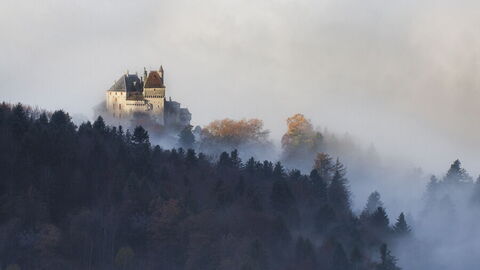
Château de Menthon-Saint-Bernard
Posted in: Architectural Gems Castles & Palaces Curiosities Must See Attractions Pretty Views Tourist Attractions
You know Sleeping Beauty's castle from the Disney logo, the one that appears at the beginning of all of those iconic films that so defined many of our childhoods? Well, it actually exists in real life and is perhaps even more beautiful in person. If you want to bring a slice of fairytale magic into your own life and your next holiday and to see this impossibly pretty architectural gem with your own eyes, then start browsing our vacation rentals in France...

In the most scenic and magical of settings that one could possibly imagine, the Château de Menthon-Saint-Bernard is perched 200m above the lovely Lake Annecy on a rocky outcrop, offering commanding views over the surrounding landscape and framed picturesquely by hills, snow-capped Alpine peaks, and woods. On misty mornings as the cream-coloured walls and pretty pointed turrets are shyly revealed, the approach to the castle seems like a road right out of our own world and onto the pages of a storybook. Discover our holiday rentals in Annecy now and get planning your trip to this mesmerising corner of the globe.
Château de Chenonceau
Posted in: Architectural Gems Castles & Palaces Must See Attractions Tourist Attractions
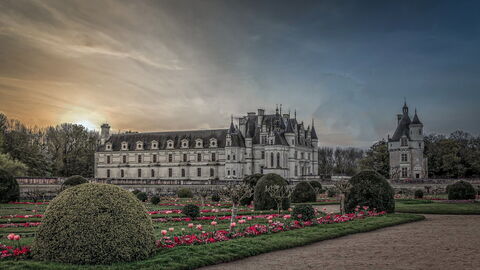
The Loire Valley of France is famously home to some of the most beautiful castles in the world. These châteaux are the closest thing that one can probably expect to find to Disney castles and fairytale backdrops and a must-see for those who have browsed our vacation rentals in Pays De La Loire and are exploring this part ofFrance. The region is home to plenty of truly magical castles but one of the best-known and most beloved examples has to be the Renaissance masterpiece that is the Château de Chenonceau.

Often described as the epitome of “feminine” gracefulness in architecture, the Château de Chenonceau, combines late Gothic and Renaissance styles of architecture in its smooth white walls, high sloped roof, pretty curved turrets and towers, plush and opulent interiors, and the elegant flower gardens that surround. This charmingly lovely and aesthetically pleasing nature led to the castle winning the hearts of endless esteemed ladies throughout history and it was, accordingly, nicknamed the, “Ladies’ Château.” Furthermore, the fingerprint of many important female figures on the building is apparent in its design, additions, and alterations.
Pompidou Centre
Posted in: Architectural Gems Museums & Galleries Must See Attractions Tourist Attractions
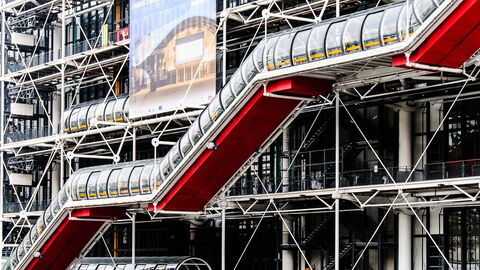
The Pompidou Centre, or Centre Pompidou, is an important art and cultural space in Paris that will likely be familiar to many for the covered external staircase that snakes across its famous facade. Located in the Beaubourg area of the 4th arrondissement of Paris, near Les Halles, rue Montorgueil, and the Marais, it was designed in a high-tech architectural style by a team of architectural juggernauts including Richard Rogers, Su Rogers, Renzo Piano, and Gianfranco Franchini.

Named after Georges Pompidou, the President of France from 1969 to 1974, and the person who commissioned the building, it was officially opened to the public in 1977 as a space to house the vast Bibliothèque publique d'information (Public Information Library), the Musée National d'Art Moderne (the largest modern art museum in Europe), and IRCAM (a centre for the research of music and acoustics). Having welcomed over 190 million visitors since opening, it is a major tourist attraction and fixture of Parisian cultural life and it is easy to understand why; an architectural gem and marvel in its own right, it also houses three such incredible cultural institutions, all under one roof.
Exterior of the Louvre
Posted in: Architectural Gems Museums & Galleries Must See Attractions Tourist Attractions
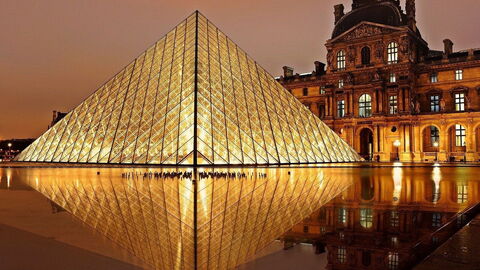
While the lucky among us may be stuck safely indoors at the moment, it does not mean that it isn't hard and frustrating. Luckily, in the time that we live in today, if you have an internet connection, you can basically explore the whole world from your own home; from attending online personal training sessions and dance classes, to doing virtual pub quizzes with pals, to screening recent cinema releases on your own television, to using Google Street View to explore cities all over the globe. In addition to all of this the Google Arts & Culture program and various schemes from different museums globally has made museums and art galleries all over the world accessible at the click of a button, with catalogues of holdings and virtual tours.

If you had been hoping to get to France this spring to enjoy the pleasant weather, lovely towns and cities, cuisine, flowers and blossom trees, and the abundant cultural wealth of her architectural gems, tourist attractions, and museums but had to postpone your trip then, fear not: all is not entirely lost because you can still visit many of the country's best and most beloved galleries...virtually!

Here is our guide to some of the best museums in France that you can visit online and for free right now!
Palais des Papes
Posted in: Architectural Gems Curiosities Museums & Galleries Must See Attractions Tourist Attractions
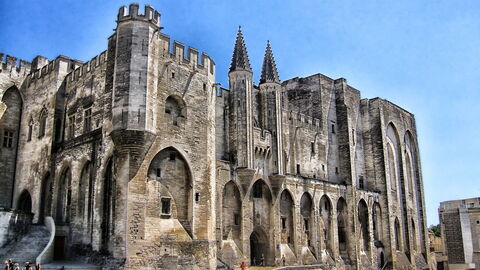
Provence, as a region, is full of incredibly beautiful sights from endless lavender fields, to ancient monasteries, to stunning beaches, to perfectly pretty medieval towns full of architectural gems. If you have found a vacation rental in Provence and are exploring the region and you are looking for particularly lovely examples of the latter, we recommend a visit to the gorgeous town of Avignon in France and to the Palais des Papes.

In 1305, Clement V was elected as Pope and famously made the decision to transfer papal power to Avignon in order to avoid the political unrest of Rome at the time. With this move, a new home for the papal seat was required and the largest medieval gothic palace in the world was built upon the foundations of an old Episcopal bishop's palace. This building, though begun under Clement V was greatly expanded under Benedict XII in 1334 and then even further under Clement VI in 1342 when he joined Benedict XII's Palais Vieux (Old Palace) and the Palais Neuf (New Palace). All of these extensions and this expansion eventually added up to create the monumental gem full of incredible objects and a rich and complex history that we know today; it covers a whopping 15,000 square metres, boasts ten fortified towers, was home to Europe's largest library at the time, excellent frescoes and fresco cycles, and much more besides.