Lascaux Cave
Posted in: Museums & Galleries Must See Attractions Pretty Views Tourist Attractions
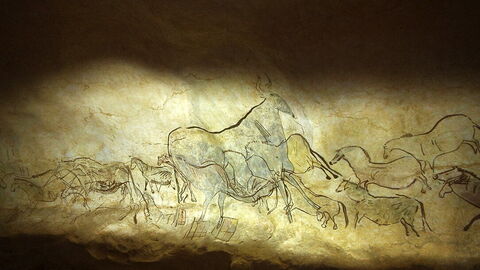
If you are visiting France, you will no doubt end up going to see a historical monument or two during your holiday and there are lots of incredible gems from the rich and complex past of the nation that are located all over the country. From the castles of the Loire Valley, to the stunning cathedrals dotted throughout the cities of France, from impossibly famous monuments like the Eiffel Tower and Arc de Triomphe to the Catacombs beneath Paris, from Roman aqueducts to whole preserved towns bombed during WWII, there are all sorts of incredible historical attractions to visit in France. However, if you are slightly more interested in a time further back, in prehistory, then you are also in luck. Lascaux Cave, or the Grotte de Lascaux, is a complex of caves near the village of Montignac that is covered in prehistoric drawings. While the original caves themselves cannot actually be visited anymore due to their deteriorating condition, there are full-scale replicas located in museums nearby that visitors can go to observe. So, if you have found a vacation rental in Montignac be sure to go and check them out!
Musée de l'Orangerie
Posted in: Museums & Galleries Must See Attractions Tourist Attractions
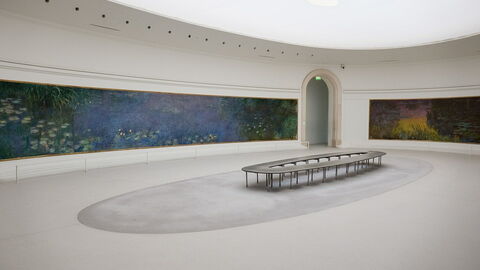
Paris is home to lots of truly incredible museums and, in particular, if you are interested in the Impressionists, you'll find ample opportunity to greet and examine some of the most iconic, beloved, representative, famous, and best examples of works from the school in various museums and galleries located around the city. However, if you have found a vacation rental in Paris and you are a Monet fan there is one museums that cannot be missed, the Musée de l'Orangerie.
Portrait of Père Tanguy by Van Gogh
Posted in: Curiosities Museums & Galleries Must See Attractions Tourist Attractions
If you have found a vacation rental in Paris and end up making your way to the beautiful Musée Rodin, you will likely be visiting with the intention to view the extraordinary works of that artist to whom the museum is dedicated and for whom it is named. However, many do not realise, until they get to the museum, that there are lots of other fascinating works of art and exceptional artists who are represented by the collection. In fact, you may be surprised to stumble across other rather famous names in addition to Rodin, such as Van Gogh.

Unlikely a work that many are immediately familiar with but a telling and beautiful example from the artist's oeuvre and readily recognisable as the distinct style of Van Gogh, the work, “Portrait of Père Tanguy” (1887) is today's Art Focus and a piece that we recommend seeking out in the Musée Rodin. Executed in attractive and bright pastel tones, the portrait of this gentleman is set against a backdrop of the Japanese prints that he sold, which were also hugely influential on Van Gogh's work and a great passion of the artist's. This piece, therefore, can be seen as a visualisation of this great inspiration and fascination of his as well as a serene and beautiful portrait of, and tribute to, one of the first art dealers to ever sell Van Gogh's work and someone whose friendship Van Gogh greatly valued. In fact, it is just one of three portraits that the artists painted of him and one of two portraits of Tanguy by Van Gogh that are on display in the Musée Rodin.
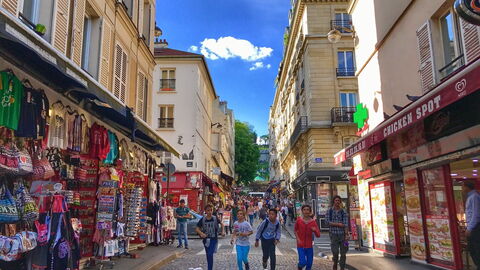
Streets of Montmartre
Posted in: Activities Curiosities Events Museums & Galleries Must See Attractions Plays & Shows Pretty Views Shopping Top 10 Lists Tourist Attractions
Montmartre is, without a doubt, the most famous Parisian district. This completely picturesque neighbourhood is now a household name and was famously home to many of the world's most beloved and best-known artists throughout the past couple of hundred years. While it has, undeniably, suffered from its own fame and mass-tourism, making the area less authentic in some ways and making it so expensive that the culture of young artists occupying the area that propelled its reputation is no longer financially viable for said young artists, there is still much to love about the area. You might just have to ignore the gaudier tat on sale in some shop windows and try and avoid times and places that attract the most oppressive tourist crowds. However, if you have found a vacation rental in Paris and you are looking for somewhere to wander around pretty streets and lush green spaces, to grab a bite, to go and take in some of the city's most famous sights, to soak up the unique atmosphere of Paris, and more, then Montmartre is not to be missed!

Located on the Butte (hill) Montmartre, the district of Montmartre was once marked by the dozen or so windmills that were visible atop the hill. Today, only a few remain; that of the Moulin Radet, the Moulin de la Galette, and the incredibly famous Moulin Rouge. An area that excavations have shown has been occupied since at least Roman-Gallo times, it was once known as “Mont de Mars,” or Mount Mars, and then became “Mont des Martyrs”, after Saint Denis, a Christian bishop, was decapitated on the hilltop in 250AD for preaching the Christian faith to the Gallo-Roman inhabitants the city. All of which eventually led to the current name of Montmartre. Until 1860, the neighbourhood was actually located just outside the city limits of Paris but it was annexed to the city that year along with other surrounding communities and became part of the 18th arrondissement of Paris, as it is today.
Pompidou Centre
Posted in: Architectural Gems Museums & Galleries Must See Attractions Tourist Attractions
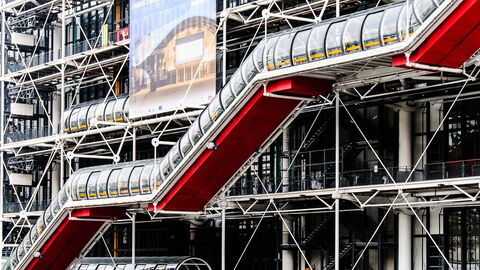
The Pompidou Centre, or Centre Pompidou, is an important art and cultural space in Paris that will likely be familiar to many for the covered external staircase that snakes across its famous facade. Located in the Beaubourg area of the 4th arrondissement of Paris, near Les Halles, rue Montorgueil, and the Marais, it was designed in a high-tech architectural style by a team of architectural juggernauts including Richard Rogers, Su Rogers, Renzo Piano, and Gianfranco Franchini.

Named after Georges Pompidou, the President of France from 1969 to 1974, and the person who commissioned the building, it was officially opened to the public in 1977 as a space to house the vast Bibliothèque publique d'information (Public Information Library), the Musée National d'Art Moderne (the largest modern art museum in Europe), and IRCAM (a centre for the research of music and acoustics). Having welcomed over 190 million visitors since opening, it is a major tourist attraction and fixture of Parisian cultural life and it is easy to understand why; an architectural gem and marvel in its own right, it also houses three such incredible cultural institutions, all under one roof.